
To quarantine new fish, keep them in a separate, cycled tank with a sponge filter, a heater and no gravel for 2 to 6 weeks before they meet your other fish. Watch them every day, keep the water clean, and treat only if you see clear signs of illness. Move them over once they have eaten well and shown no symptoms for at least 14 days in a row.
That is the short version. The rest of this guide shows you exactly how to do it, even if you have never set up a second tank before.
Most fish that die in a new home do not die from bad luck. They bring something with them: ich, fin rot, flukes or a bacterial infection picked up in a crowded store tank. A quarantine period catches that problem in a small tank you can treat cheaply, instead of in your display tank where it can wipe out fish you have kept for years.
In this guide you will learn:
- When quarantine is worth it, and the few times you can skip it
- How long to quarantine based on where your fish came from
- A simple quarantine setup that costs less than one replacement fish
- A day-by-day schedule you can follow from day 1 to day 30
- Which warning signs matter, and when to medicate
- How to quarantine shrimp, snails and plants
- The mistakes that undo all your hard work on the last day
Why Quarantine New Fish?
A quarantine tank is a small, separate aquarium where new fish live alone for a few weeks. It does three jobs at once.
- It stops disease at the door. Store fish are stressed by shipping, crowding and constant handling. Stress weakens their immune system, so parasites and bacteria that were sleeping can flare up a few days after you bring them home.
- It makes treatment cheaper and safer. A 10 gallon quarantine tank needs a tenth of the medicine a 100 gallon display tank does. You also avoid harming plants, snails, shrimp and the beneficial bacteria in your main filter.
- It gives new fish a calm place to recover. No bullies, no competition for food, and a dim, quiet tank help a shy fish start eating sooner.
There is also a simple numbers argument. Disease spreads more easily when a lot of pathogens are present at once. A few parasites on one healthy fish may never cause trouble, but a fresh outbreak in a crowded tank can. Quarantine keeps that first wave contained.
When can you skip quarantine?
Quarantine is always the safer choice, but there are a few cases where the risk is low:
- Your very first fish in a brand new tank. There are no other fish to protect yet, so the display tank is the quarantine tank.
- Fish from a trusted breeder you have bought from before, going into a tank that only holds fish from that same source.
- Snails from a trusted source. Many keepers only rinse and inspect them (more on that below).
You should never skip it when you buy from several different stores, order fish online, add sensitive species such as discus or wild-caught fish, or add anything to a tank that has been stable for a long time.
How Long Should You Quarantine New Fish?
Quarantine new fish for 2 to 6 weeks, depending on where they came from. If any illness shows up, the clock restarts from the last day you saw a symptom.
You will see different numbers online because the risk is different for each source. Here is a simple way to choose:
Where the fish came from
Risk level
Minimum quarantine
Notes
Trusted local breeder or hobbyist you know
Low
2 weeks
Observe and feed. Treat only if symptoms appear.
Local fish store with clean, healthy tanks
Medium
3 to 4 weeks
Ask how long the fish have been in the store. Fresh arrivals carry more risk.
Big chain pet store
Medium to high
4 weeks
Fish often move through many systems quickly.
Online or mail-order shipment
High
4 weeks
Shipping stress is high, so watch the first 7 days closely.
Wild-caught or sensitive species (discus, many loaches, rare imports)
High
6 weeks
Internal parasites and worms are more common.
Saltwater fish
High
4 to 6 weeks
Marine ich and velvet move fast. Copper or tank transfer methods are common.
Why 4 weeks for most fish? Many common parasites have life cycles that run their course within a few weeks at tropical temperatures. Keeping new fish isolated long enough lets a hidden problem show itself before it reaches your main tank.
The 14-day rule: whatever the source, only move fish once they have gone at least 14 days in a row with no symptoms, normal breathing and a good appetite.
How to Set Up a Quarantine Tank
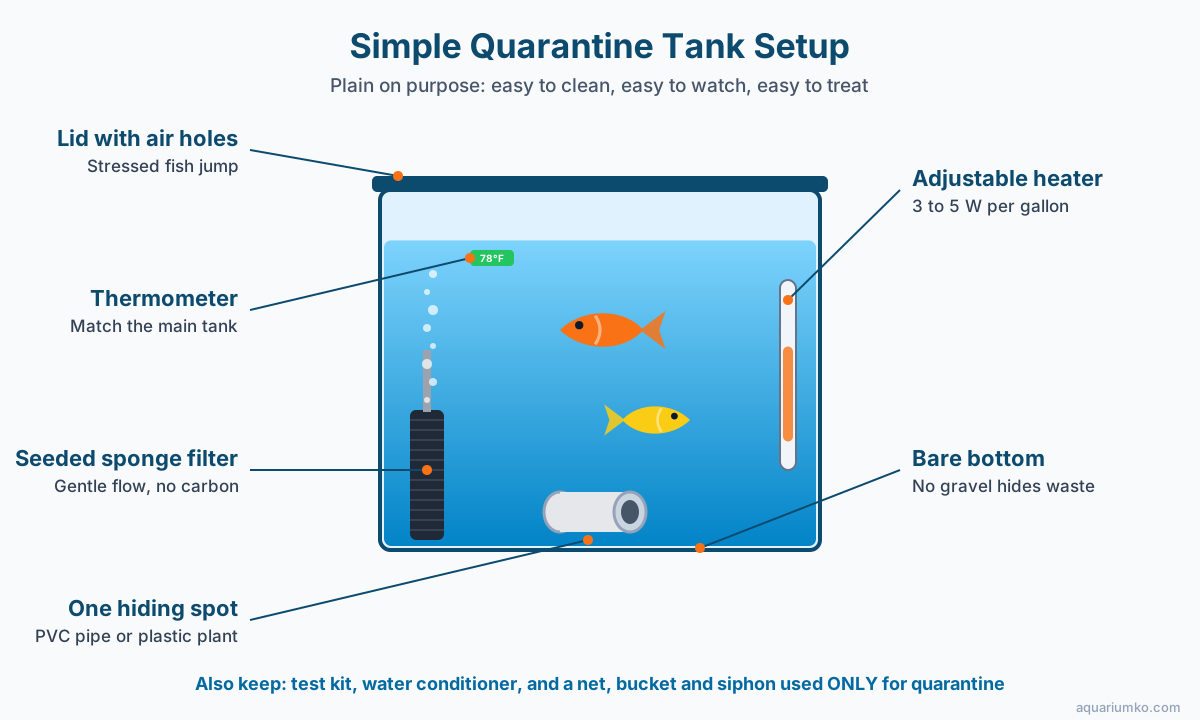
A good quarantine tank is plain on purpose. Bare glass, one hiding spot and gentle filtration make it easy to see waste, spot illness and keep the water clean.
What you need
Item
Why it matters
Tips
Tank or tub (10 gallons for small fish, 20 to 30 gallons for larger fish)
Small volume means less medicine and easier water changes
A clear, food-safe plastic storage tub with a lid works fine.
Sponge filter and small air pump
Gentle flow, easy to seed with bacteria, and it will not remove medicine
Avoid carbon cartridges during treatment. Carbon pulls medication out of the water.
Adjustable heater
Keeps temperature steady, which lowers stress
About 3 to 5 watts per gallon. Set it to match your main tank.
Thermometer
Confirms the heater is working
Check it every day.
Lid
Stressed fish often jump
Drill small air holes and a notch for cords if you use a tub.
One hiding spot
Hidden fish feel safe and start eating sooner
A short piece of PVC pipe or a plastic plant is easy to clean.
Water test kit
Ammonia and nitrite can rise fast in a small tank
Test at least twice a week.
Water conditioner
Removes chlorine and chloramine from tap water
Use it on every water change.
Separate net, bucket and siphon
Shared tools carry disease between tanks
Label them "QT only" and never use them on the main tank.
Skip gravel and real plants. Gravel hides waste and uneaten food, and some medicines harm live plants.
The budget option: no second aquarium needed
You do not need a glass tank. A clear plastic storage tub, a sponge filter, a heater and a lid make a working quarantine setup. When you are not using it, the tub stacks away in a closet. Even a clean bucket works in an emergency for a day or two.
Cycle the quarantine tank before the fish arrive
An uncycled tank builds up ammonia within days, and that alone can make a new fish sick. Use one of these methods:
- Best: keep a spare sponge filter running in your main tank. It fills with beneficial bacteria. On quarantine day, move it straight into the new tank.
- Good: borrow some used filter media from your main tank and squeeze it into the new sponge filter. Never take your main filter's best media.
- Backup: use a bottled bacteria starter and feed very lightly for the first week while you test the water often.
Fill the quarantine tank with about half water from your main tank and half fresh, conditioned tap water. This keeps pH and hardness close to what the fish will live in later.
Place it in a quiet room away from your main tank if you can. Splashing water and shared airlines can carry pathogens between tanks that sit side by side.
How to Quarantine New Fish: 7 Steps
- Prepare the tank a day early. Set up the cycled filter, heater and lid. Match the temperature to your main tank and test for ammonia and nitrite. Both should read 0 ppm.
- Inspect the fish at the store. Pass on any fish with white spots, clamped fins, torn fins, sunken bellies or heavy breathing. Avoid buying from a tank that has dead fish in it.
- Acclimate slowly. Float the closed bag for 15 minutes to match temperature. Then add a small cup of quarantine tank water to the bag every 5 minutes for 20 to 30 minutes. Net the fish into the tank and throw the bag water away. Never pour store water into your tank.
- Keep the lights off for the first day. Darkness lowers stress after shipping and handling.
- Feed lightly from day 2. Offer a small pinch once a day. Remove anything not eaten within 2 minutes so it does not foul the water.
- Observe every day and test twice a week. Use the warning signs table below. Change 20 to 25 percent of the water once or twice a week, or more often if ammonia or nitrite shows up.
- Treat only what you see, then finish the clock. If symptoms appear, treat the specific problem and restart your 14-day symptom-free count from the last day you saw it.
Day-by-day quarantine schedule
Print this or save it to your phone.
File: fish-quarantine-timeline.png. Alt text: Fish quarantine timeline from day 1 acclimation to day 42 release for high-risk fish.
Days
What to do
What to watch for
Day 1
Acclimate, lights off, no food
Heavy breathing, lying on the bottom
Days 2 to 3
First small feeding, lights on low
Is the fish eating? Clamped fins?
Days 4 to 7
Feed once a day, test water twice
White spots, fuzzy patches, red streaks
Day 7
First 25 percent water change
Ammonia or nitrite above 0 ppm
Days 8 to 14
Normal feeding, keep testing
Weight loss, stringy white poop, flashing (rubbing on objects)
Day 14
Water change, check overall condition
Low-risk fish can move if fully healthy
Days 15 to 28
Weekly water changes, daily checks
Any new symptom restarts the 14-day count
Day 28 to 30
Final check
Most store and online fish are ready to move
Day 42
Final check for high-risk fish
Wild-caught, sensitive and saltwater fish
Should You Medicate New Fish During Quarantine?
There are two accepted approaches, and both work when you follow them carefully.
Approach
How it works
Best for
Observe and treat
Feed, watch and keep water clean. Medicate only when a clear symptom appears.
Fish from trusted breeders and clean local stores. Beginners who want fewer chemicals in the water.
Preventive treatment
Give a short course of broad treatments in the first week, usually one for parasites, one for bacteria and one for ich, then observe for the rest of the period.
Fish from chain stores, online shipments, wild-caught fish and anyone with a big, valuable display tank.
If you choose preventive treatment, follow these rules:
- Use the label dose for the actual water volume, not the tank's advertised size. Decorations and gaps at the top reduce real volume.
- Remove carbon from the filter and turn off any UV sterilizer during treatment.
- Add an air stone. Many medicines lower oxygen in the water.
- Check that each medicine is safe for your species. Scaleless fish, such as many loaches and catfish, and all invertebrates are more sensitive.
- Some medicines can weaken your filter bacteria. Test for ammonia more often while treating.
- Never mix medicines unless the labels say it is safe.
Aquarium salt is a gentle option some keepers use for mild stress and slime coat support in freshwater fish. Do not use it with plants, snails, shrimp or salt-sensitive fish, and follow the package dose.
Warning signs to watch for
File: healthy-vs-sick-fish-signs.png. Alt text: Checklist comparing signs of a healthy fish with warning signs of disease during quarantine.
What you see
What it may mean
What to do
Small white grains like salt on body and fins
Ich (white spot disease)
Start an ich treatment and keep the temperature stable.
Ragged, shrinking or white-edged fins
Fin rot (bacterial)
Increase water changes and use an antibacterial treatment if it spreads.
Cotton-like fuzzy patches
Fungus or columnaris
Treat quickly, columnaris can spread within days.
Rubbing against objects (flashing), fast gill movement
Gill flukes or other external parasites
Use a parasite treatment that targets flukes.
Sunken belly while still eating, stringy white poop
Internal parasites or worms
Use a medicated food for internal parasites.
Gasping at the surface
Low oxygen or high ammonia
Test water now, do a water change and add aeration.
Cloudy eyes
Poor water quality or bacterial infection
Check water first, then treat if it does not clear.
Hiding and not eating for 3 or more days
Stress, wrong water conditions or early illness
Check temperature and water, dim lights, offer varied food.
When in doubt, change water first. Clean water fixes more early problems than any medicine.
Quarantining Shrimp, Snails, Plants and Saltwater Fish
Shrimp
Shrimp can carry parasites and bacteria too, but most fish medicines are deadly to them. Quarantine shrimp in a mature tank with a seeded sponge filter and some biofilm or moss to graze on. Observe them for 2 to 4 weeks and do not pre-treat.
Snails
Snails rarely spread fish diseases, but they can bring in pest snails and eggs. Rinse them in conditioned water, check the shell for eggs and hitchhikers, and keep them in a cup or small tank for a week if you want extra safety.
Live plants
Plants are the most common way pest snails, planaria and algae get into a tank. Rinse plants well, remove rock wool and dead leaves, and inspect leaf undersides for eggs. Lab-grown tissue culture plants in sealed cups are the safest choice because they are pest-free.
Saltwater fish
Marine fish need the strictest quarantine. Marine ich and velvet can kill a reef tank in days. Common methods include copper treatment with a copper test kit, the tank transfer method and long observation periods. Copper is toxic to corals and invertebrates, so it is only ever used in the quarantine tank. Plan for at least 4 to 6 weeks.
Moving Fish From Quarantine to the Main Tank
Your fish are ready when they eat eagerly, swim normally, have clear eyes and full fins, and have gone at least 14 days with no symptoms.
- Test both tanks and compare temperature, pH and hardness
- Acclimate the fish to main tank water the same slow way you did on day 1
- Move the fish with a net, never pour quarantine water into the main tank
- Turn the main tank lights off for a few hours and add the new fish at feeding time to reduce aggression
- Watch the whole tank closely for the next week
Cleaning the quarantine tank afterward
If the fish stayed healthy, you can keep the sponge filter running in your main tank so it is ready for next time. If there was a disease, clean everything: empty the tank, scrub it, soak equipment in a mild bleach solution, rinse very well, let it dry completely, and dechlorinate before reuse. Throw away cheap filter sponges used during an outbreak.
8 Common Quarantine Mistakes
- Using an uncycled tank. Ammonia stress can cause the very disease you were trying to avoid.
- Ending quarantine too early. A fish that looks fine on day 5 can show ich on day 9.
- Sharing nets, buckets and siphons. One wet net can carry parasites straight into your main tank.
- Pouring store water into your tank. Always net the fish out of the bag.
- Overfeeding. Small tanks foul fast. Feed small amounts and remove leftovers.
- Medicating without a reason or at the wrong dose. Guessing at doses stresses fish and can kill invertebrates and filter bacteria.
- Adding new fish to the quarantine tank partway through. This resets the clock for everyone. Run separate batches when you can.
- Forgetting the heater. Temperature swings in a small tank are a major source of stress.
Watch: Quarantine Setup Videos
Prefer to see it done? These two short videos walk through a simple setup and a basic medication routine.
- How to Quarantine New Fish in 2 Minutes by Girl Talks Fish (embed: https://www.youtube.com/embed/Z8WMVVT4b7I)
- How to Quarantine and Medicate New Fish by Dans Fish (embed: https://www.youtube.com/embed/smT481s5Kik)
Frequently Asked Questions
How long should I quarantine new fish?
Most new fish need 4 weeks. Fish from a trusted breeder can be ready after 2 weeks, while wild-caught, sensitive and saltwater fish need about 6 weeks. In every case, wait for 14 days in a row with no symptoms.
Can I quarantine fish without a quarantine tank?
Yes. A clear plastic storage tub with a sponge filter, heater and lid works well. For a day or two in an emergency, a clean bucket with an air stone and heater can hold a fish.
Does a quarantine tank need to be cycled?
Yes. Move a mature sponge filter or used filter media from your main tank into it. An uncycled tank can build up ammonia within days and make new fish sick.
Should I put gravel in a quarantine tank?
No. A bare bottom makes it easy to spot waste and leftover food, and it is simple to clean after a disease.
Can I add more fish to the quarantine tank later?
You can, but it restarts the quarantine clock for every fish in the tank. Quarantine one batch at a time when possible.
Do I need to quarantine fish from a good local store?
It is still a good idea. Even clean stores receive new shipments often, and stressed fish can show illness a week after you buy them. A 3 to 4 week quarantine is a safe middle ground.
Do snails and shrimp need quarantine?
Shrimp should be observed in a mature tank for 2 to 4 weeks without medication. Snails mostly need rinsing and inspection for eggs and pest snails.
What temperature should a quarantine tank be?
Keep it the same as your main tank. A steady temperature lowers stress and makes moving the fish later much easier.
Final Thoughts
Quarantine feels slow when you are excited about a new fish. But 4 weeks in a plain tub is far cheaper than treating a whole display tank or replacing fish you have kept for years. Set up a simple tank, keep the water clean, watch every day, and only move fish once they have earned a clean bill of health.
Next, learn how to acclimate new fish and how to spot common freshwater fish diseases early.